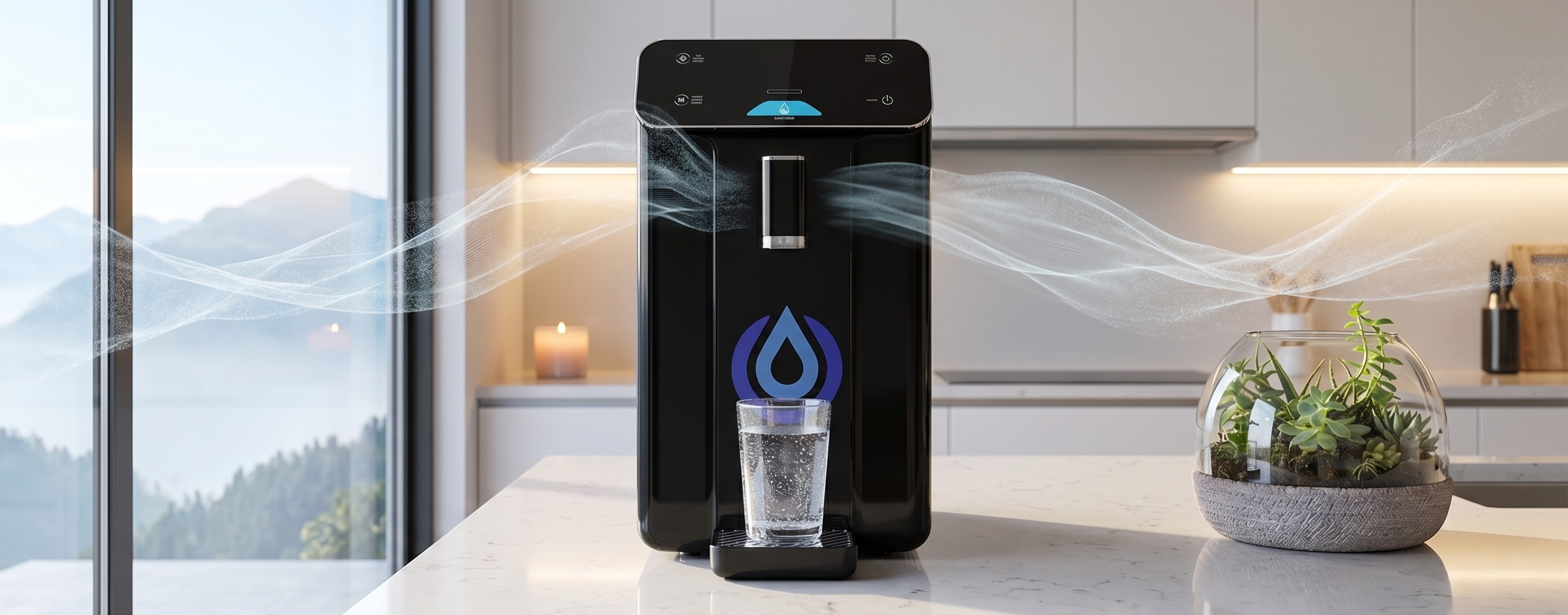
As global clean water reserves deplete and climatic patterns shift, atmospheric water generation (AWG) has emerged as a revolutionary, decentralized solution to harvest pure drinking water directly from the air we breathe.
Atmospheric water generators tap into the earth's hydrological cycle, replicating the natural processes of dew point condensation and rain formation inside a self-contained mechanical system. In regions suffering from chemical groundwater contamination or severe seasonal drought, these systems provide a critical lifeline of pure, local drinking water.
How Does Atmospheric Water Generation Work?
The core technology relies on thermodynamic principles of moisture extraction. An AWG pulls ambient air through highly efficient particulate filters, passing it over advanced cooling coils. When the air temperature is lowered below its dew point, water vapor transitions from a gas state into liquid droplets, which collect on specialized condensation surfaces.
The Multi-Stage Purification and Mineralization Cycle
Extracting the water is only the first step. To ensure it is safe, refreshing, and rich in essential nutrients, the harvested water undergoes a comprehensive sterilization process:
1. HEPA Air Filtration
Before moisture is condensed, incoming air goes through HEPA filters to block dust, microscopic particles, pollen, and environmental impurities.
2. UV-C Sterilization
The liquid water is immediately treated with high-intensity ultraviolet (UV-C) lamps in the collection tank, neutralising 99.9% of bacteria, viruses, and microbial contaminants.
3. Active Carbon and RO Filtration
Water passes through multi-stage carbon and reverse osmosis (RO) filters, removing trace volatile organic compounds (VOCs) and chemical pollutants.
4. Remineralization and Enrichment
Harshly distilled water lacks taste and health benefits. The purified water passes through mineral cartridges that slowly release balanced concentrations of calcium, magnesium, and trace elements, yielding clean, alkaline drinking water.
Environmental and Sustainability Impact
Unlike groundwater extraction, AWG does not deplete local aquifers or damage regional ecosystems. The atmosphere acts as a massive, self-renewing reservoir holding billions of liters of water vapor. Using smart solar-assisted AWG grids, remote communities, military outposts, and emergency response teams can establish instant drinking water access without requiring municipal pipelines.
AMFAH's Air-to-Water Solutions
At AMFAH India, we offer state-of-the-art Atmospheric Water Generators engineered for high efficiency even in moderate relative humidity environments. Our units feature smart microprocessors to optimize energy consumption and maximize water extraction based on ambient temperature and relative humidity envelopes
Conclusion
Harvesting water from air is no longer a concept of the far future; it is a proven, commercialized engineering standard. By integrating atmospheric water generators into homes and commercial facilities, we can secure clean drinking water independent of natural resource scarcity.